

How To Use Template Powerpoint
In this epic PowerPoint tutorial, you'll learn how to create a PowerPoint template from scratch.
What is a PowerPoint template and why exercise yous need one?
In short, a template is a set of pre-built slide layouts and defined formatting to help you speedily create make consistent and professional PowerPoint presentations.
Below is an case of the properly built template you'll learn how to create in this tutorial.

Time Saving Tip:You can save yourself a agglomeration of time by kickoff buying a professional PowerPoint template and so tweaking information technology to encounter your needs.
To see the 4 best places I recommend finding professional PowerPoint templates online (and why I like them), read my guide here.
If yous and your team make lots of PowerPoint presentations, a properly built template tin can save yous THOUSANDS of hours building and editing your slides (no joke).
On the flip side, if your template is cleaved (which many are), it tin can make working in PowerPoint a nightmare.
Chances are that if your current PowerPoint template is difficult to work with, you are using a cleaved template. This tutorial volition assist you fix information technology (fast).
To larn how to create your own custom PowerPoint theme (that you tin use with your template), read my guide here.
Part #1. Creating Your PowerPoint Template Slide Backgrounds
In the commencement office of this tutorial, you'll discover how to create your own slide backgrounds and how to:
- Build the overall frame for your template
- Employ and navigate the PowerPoint Slide Chief (and how the Parent and Child
- Slides work together)
- Employ the different paste special options
- Add a pattern background to your slide
- Crop images to fit your unabridged slide groundwork
- Add together a radial gradient make full to a shape with transparency
- Add together new guides and move them around on your Slide Master
- And more!
Additional template resources: If y'all're not 100% clear on what exactly a PowerPoint template is, read my guide here.
And for a list of questions I recommend request yourself earlier you build your template, read my guide here.
1. Ready the colors for your template
The first step is to select a color scheme for your template. You can hands do that in the Design tab, nether Variants.
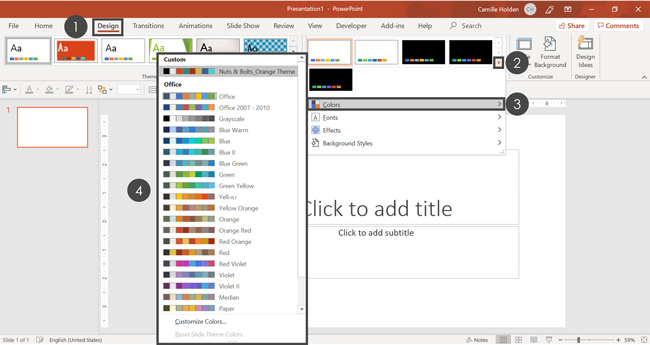
To choose a color scheme for your PowerPoint template, simply:
- Navigate to the Blueprint tab
- Open the More than variants options
- Click on Colors to open up the dropdown
- Select the color scheme you want to utilise
If you want to use a color scheme that isn't listed hither, y'all can create your own. To learn how to create your own custom PowerPoint theme, including colors, font combinations, and shape furnishings, read my guide here.
Selecting a new PowerPoint theme changes all the default colors you take to work with inside your presentation (allowing you to maintain consequent formatting throughout).
Your theme colors will be reflected in all of your color dropdowns as pictured below (with pre-populated variants for those colors).
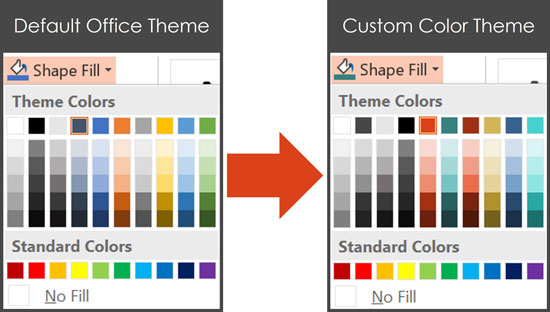
Annotation: Selecting your own custom theme colors does not replace the standard colors at the lesser of your formatting dropdowns. You cannot change these Standard Colors, unfortunately.
2. Set the fonts for your template
To navigate to your PowerPoint Slide Master, simply:
- Navigate to the View tab
- Select the Slide Principal control
The next step is to select a font pairing for your template, which y'all can too exercise in the Blueprint tab, under Variants.
NOTE: This is one of my acme PowerPoint template tips, and is one you don't want to mess up. To encounter my 9 other pinnacle tricks for your PowerPoint templates, read my guide here.
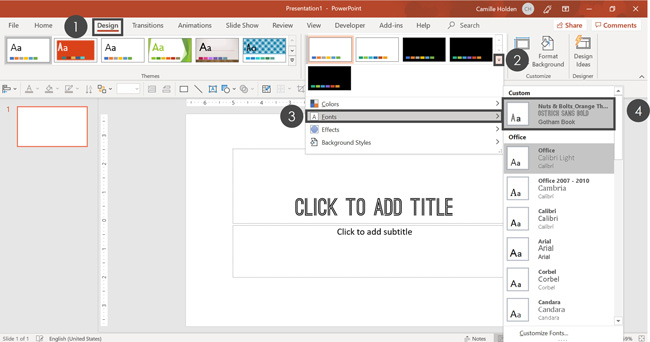
To cull a new font combination for your PowerPoint template, but:
- Navigate to the Blueprint tab
- Open the More variants options
- Click on Fonts
- Select the font combination you lot want to apply
Later on selecting your new font combination, all the placeholders throughout your presentation will automatically update to your new font styles.
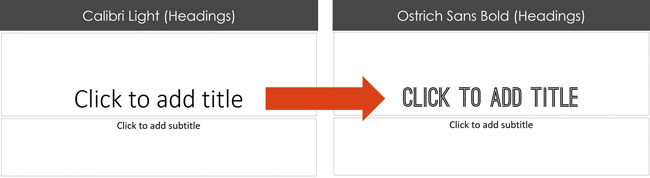
The power to make this kind of macro level formatting is ane of the major benefits of creating a PowerPoint template. You set your formatting in one identify, and it updates throughout your entire presentation (amazing!).
Once you lot have your colors and fonts selected, y'all are ready to create the framework. This includes your slide backgrounds and other mutual design elements you will desire in your presentation.
3. Navigate to the Slide Master View
In order to properly create the slide backgrounds for your template, you lot'll need to create a presentation framework on the Slide Master.
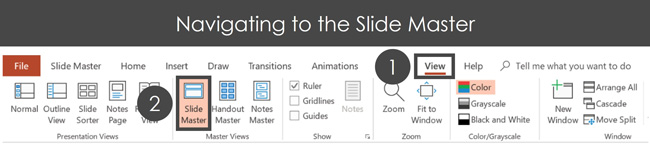
To choose a new font combination for your PowerPoint template, simply:
- Navigate to the View tab
- Select the Slide Master command
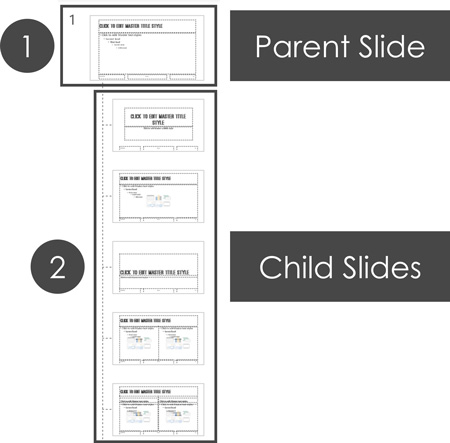
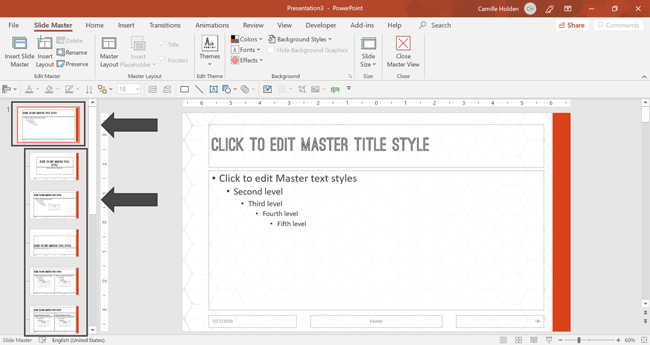
Inside the Slide Master, you'll run across two sets of slides on the left as pictured below:
#1. The Parent Slide (the bigger slide) is where you desire to make the macro-level edits that you want to meet reflected on the majority of your slides. For example, this is likely where y'all will want to see things like your company logo or any corporate branding design element.
#ii. The Child Slides (the smaller slides) are where you want to customize the individual layouts. For case, your title slides and divider slides may expect quite unlike from the rest of your slides, which is why they'll accept their own Child Slides.
Warning: Although you tin can delete the Child Slide layouts within a presentation, I don't recommend it.
Every bit Julie Terberg and Echo Swinford point out in their book on templates, "Building PowerPoint Templates Footstep past Stride with the Experts", if y'all delete these Child Slide layouts, you are likely to meet formatting bug and errors when copying and pasting between your templates down the road.
And then unless you are 300% certain you are never going to use these layouts (and nobody on the planet is ever going to send you a slide deck with one of these layouts), I don't recommend deleting them.
4. Customize your Parent Slide background
At present that you are on your Slide Principal, y'all'll desire to first by formatting your Parent Slide.
That'southward considering the formatting that you lot prepare on your Parent Slide will bear upon all of the other slide backgrounds within your template.
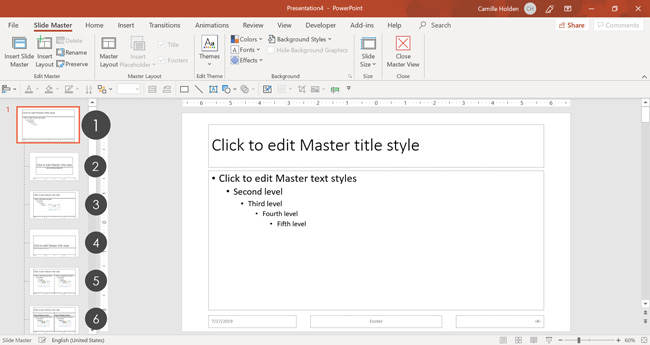
A. Choose your PowerPoint template's background
Next, yous are going to format your slide background with the various design elements yous want for all your slides.
In the example beneath, I've called a pattern for my template that is minimalist and modern. Yous tin can download and insert any picture or pattern yous want to use as your slide groundwork image.
To expand your knowledge and acquire how to create PowerPoint backgrounds using the Designer feature (and how to troubleshoot it), read our guide here.
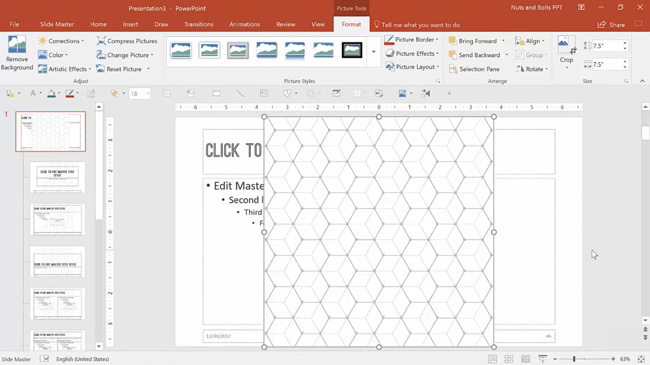
B. Crop to Aspect Ratio
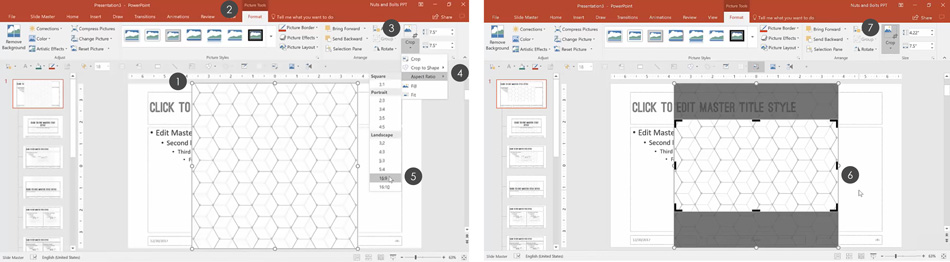
If you lot are using a motion picture for your slide background, the fastest way to make it fit on your slide is to crop it using the Aspect Ratio Crop tool. To practice that, but:
- Select the background epitome you have pasted on the slide
- Navigate to the Format tab
- Open up the Crop dropdown
- Open the Aspect Ratio options
- Choose your attribute ratio. In the moving picture above I chose xvi:9 for widescreen to friction match my slide dimensions (another common aspect ratio is 4:3 for printed slides).
- Adjust your photo within the frame
- Hit the Crop command again or hit Esc on your keyboard
This will make resizing the prototype to fit your template much easier without having to worry near whatsoever warping.
To learn more about the cropping pictures in PowerPoint, read our guide here.
C. Fill up out your slide background
To make the epitome fit your entire slide space, at that place are two options.
Selection #1. Yous can merely elevate the handlebars to expand the prototype. Just make sure you concur the Shift key while yous enlarge your image, then y'all don't accidentally warp it.
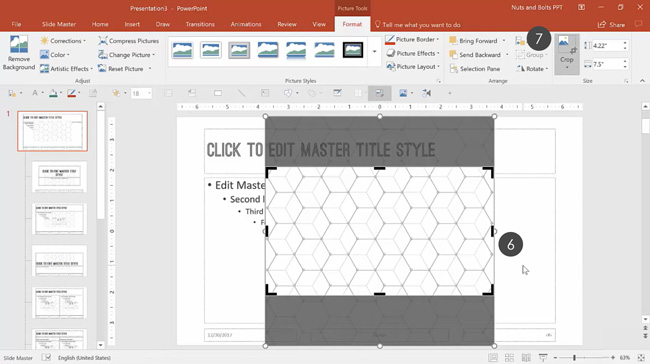
Option #2. You lot can resize your epitome more precisely:
- In the Shape Width box, enter xiii.33 and hit Enter on your keyboard
- Elevate the image in the center to fit the entire slide
NOTE: In my example in the video higher up, I wanted a smaller pattern. That's why I duplicated the background prototype and then that I have ii smaller images next to each other.
And then I fabricated sure to group the two images together then that they office equally a unit. To learn all about group in PowerPoint, check out our guide hither.
The final example of the background shown beneath is the result of that. And because the image is attack the Parent Slide like this, by default information technology will bear witness up equally all of the slides in my PowerPoint template.
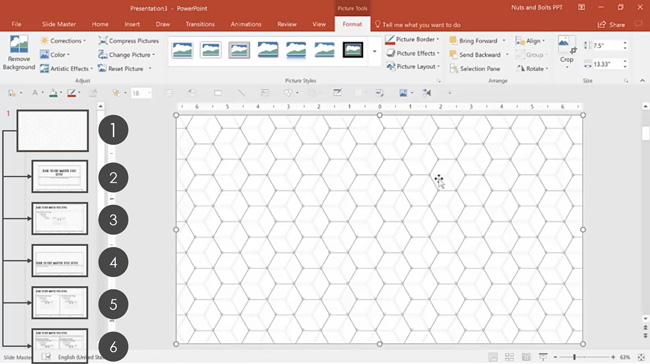
Afterward resizing your background prototype, you lot will want to send it back backside all other elements.
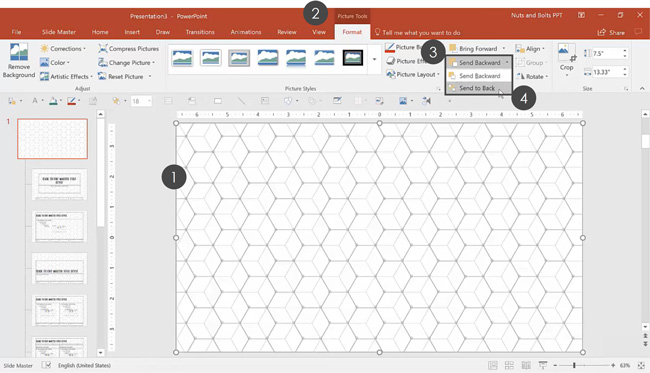
To send the image backward, only:
- Select your background prototype
- Navigate to the Picture Tools Format tab
- Click on the Ship Backward dropdown
- From the dropdown menu, select Send to Back
This sends the background behind the text every bit shown in the moving-picture show beneath. This makes all the Parent Slide content placeholders visible again on your slide.
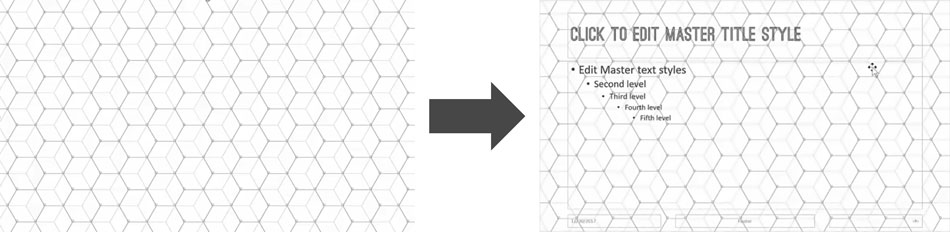
D. Create a semi-transparent gradient layer
With the slide groundwork set for my PowerPoint template, I'm additionally going to make the slide background less visible past calculation a semi-transparent layer.
That's because as y'all can see in the film below, the text is not crystal clear against the background prototype I used. This volition go far difficult for people to read my slides during a presentation.
In the steps below, I will use the old method (non-Function 365 subscription) for creating a transparent groundwork in PowerPoint. If yous have an Office 365 subscription and want to run across the make-new way to create a transparent image, encounter our guide here.
Step #1. Insert and format a rectangle
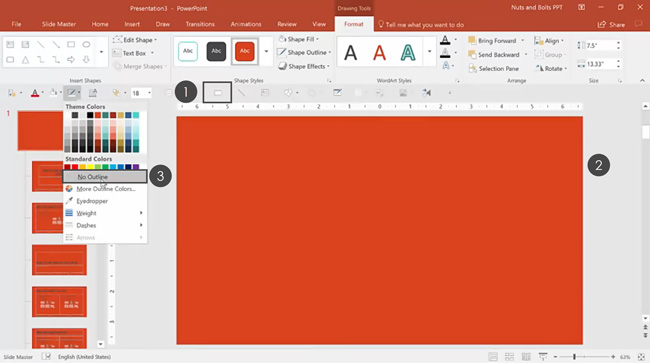
To insert and format a rectangle in PowerPoint, just:
- From the Insert Tab, click on the Shapes gallery, and select a rectangle (mine is on my QAT).
- Describe in the rectangle so that it covers your entire background prototype (for this to work, your rectangle needs to be the aforementioned exact size as the image you want to make transparent).
- Remove its outline by going to the Shape Outline dropdown and selecting No Outline.
Footstep #two. Add a gradient fill
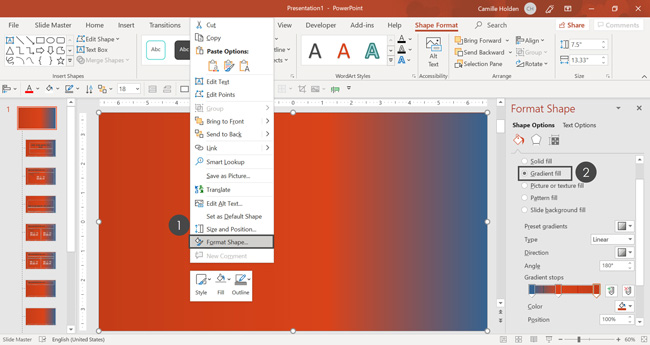
With the rectangle still selected, make the following adjustments:
- Select your rectangle and click Format Shape to open the Format Shape dialog box. This gives you a wide diverseness of formatting options you can use to format your shape backgrounds for your template.
- Select the Gradient fill.
- In the Blazon dropdown, select Radial.
- For the Direction, select the "from center" option (in the middle).
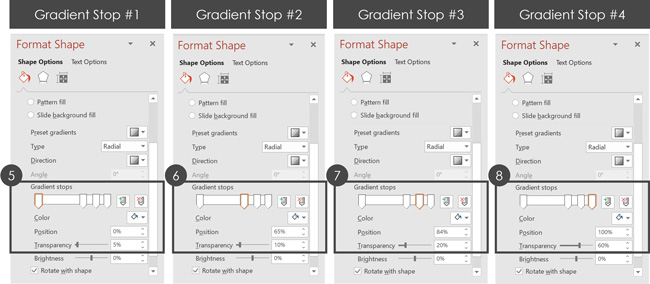
- In the Gradient stops bar, select the first gradient stop, and from the fill Color dropdown, select white. Nether Transparency, enter 5 %. Then that it well-nigh looks 100% white in the eye.
- Side by side, select the second gradient bar and drag it to the correct. From the fill Color dropdown, select white. For Transparency, enter 10%.
- So, select the third gradient bar and drag it to the right. From the make full Color dropdown, select white. For Transparency, enter 10%.
- Finally, select the last gradient bar and drag it to the right. From the fill Colour dropdown, select white. For Transparency, enter 60%.
Using the gradient make full options described above, your rectangle should wait similar mine, with some of your text bleeding through information technology.
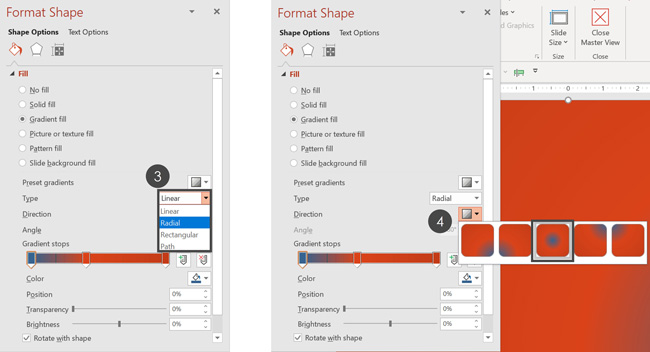
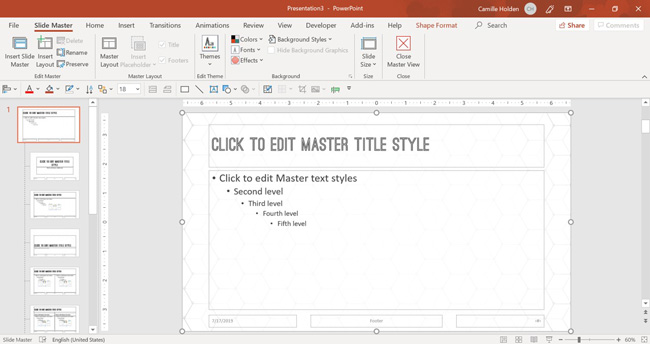
Shut the Format Shape pane and yous're all set with your slope formatting.
As a final step, right-click your gradient rectangle and select Send to Back and so Transport Forwards so that information technology sits behind your placeholders only on top of your pattern groundwork.
5. Add a slide groundwork design element
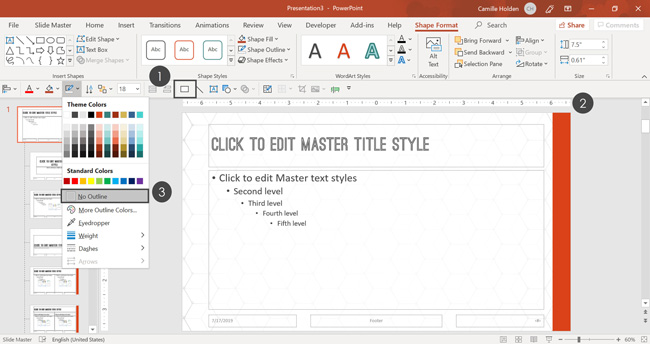
Equally a next stride, I'grand going to add a vivid bar down the correct-side of my slide as a nice design element. To practice that, merely:
- Navigate to theInsert tab and select theShapes dropdown.
- Select aRectangle and draw it on the right-paw side of your slide. Make sure to place it on the edge of your slide.
- Select No Outline
Note: Make sure y'all are adding this to your Parent Slide and non a Child Slide. This automatically populates the design element on all the Child Slides.
That's the power of creating a PowerPoint template – yous add a design element in one place, and it shows up throughout your presentation.
6. Add together and edit your guides
In PowerPoint, guides aid with formatting, positioning, and slide-to-slide consistency.
Consider guides as the anchors on your slide that help you lot to consistently align your objects. It'due south an optional step, simply I recommend adding them to your template.
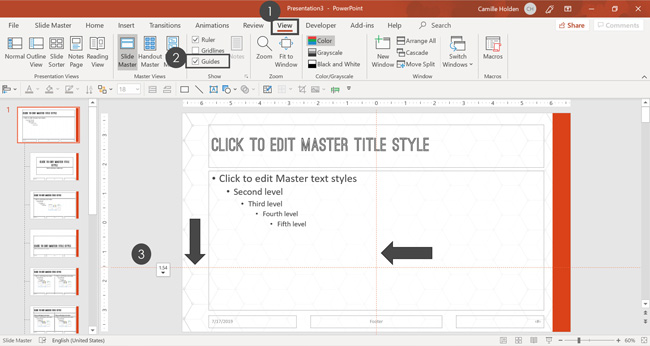
To add guides to your PowerPoint template, only:
- Click on the View tab
- Select Guides. Notice that there are two guides: 1 vertical and one horizontal.
- To move a guide, place your mouse over it, and when your cursor becomes a double-headed pointer, elevate the guide to where y'all desire information technology on your slide.
For at present, I volition simply place my guides on the edges of the slide, to create a "bleed area" in case part of the presentation gets cut off in impress.
We will look at adding more guides in part #two of this series.To add a new guide, just showtime dragging an existing one, and then striking the Ctrl key on your keyboard before you let go.
Depending on how yous ready your guides, they tell users where they should and shouldn't be placing content on your slides.
Function #ii. Setting up your template placeholders and footers
With your slide groundwork now set upwards, let'southward nail downward the following three placeholders on theParent Slide:
- Championship placeholder
- Content placeholder
- Engagement and time, Footer, and Slide Number placeholders
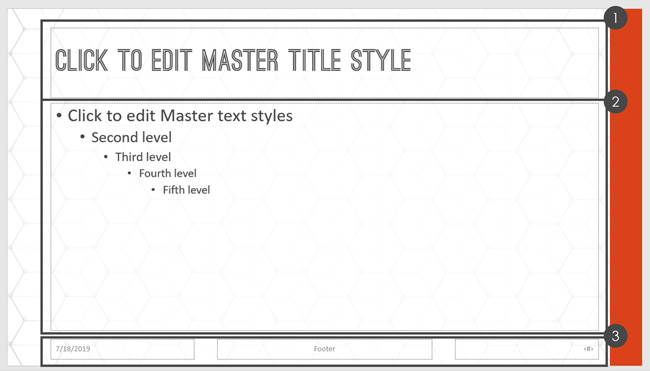
And even if you lot don't desire to utilise these placeholders on all of your slides, it'southward still of import to set and format them on your Parent Slide.
Why? Because if yous don't, you run the take a chance of letting default formatting slip through the cracks and ruin an otherwise perfect template.
Later in this tutorial, yous'll learn how to tweak your slide layouts abroad from the Parent Slide if that'due south what you lot want to do.
1. Format the Championship placeholder
There are a number of ways in which you tin can format your placeholders and there is no right or wrong formatting.
But before we dive into that, permit'due south talk about what placeholders are.Placeholders are blank spaces that are designated for certain types of content.
Yous set these on your Slide Master so that they are locked when people fill them in when edifice their PowerPoint slides using your template.
Three keys to think about your content placeholders are:
- They can simply be set and edited (for real) on your Slide Master.
- Only text typed into your placeholders volition testify in the Outline View of your presentation.
- Only text that has been typed into your placeholders will change fonts automatically when you change your theme'southward fonts.
To learn all nearly the Outline View in PowerPoint and how to apply information technology, read our article hither.
You can change the font size, alignment, size, position, etc. of your placeholders to meet your requirements. Beneath I'll run you through the most mutual formatting elements.
A. Change the font size
Before you start formatting your placeholders, make sure you are on your Parent Slide. Nosotros will focus on formatting your Child Slide layouts later.
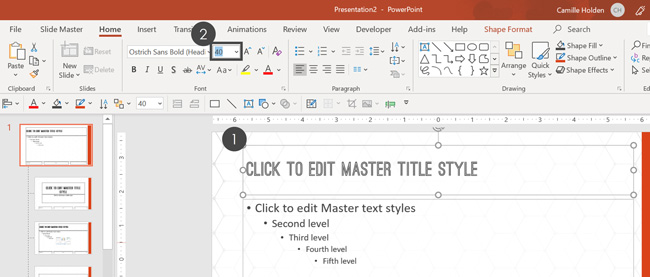
As a beginning footstep, let'south modify the font size of the title placeholder:
- Select your title placeholder
- In the Font Size dialog box, enter forty (or whatever size yous want)
B. Resize and position the placeholder
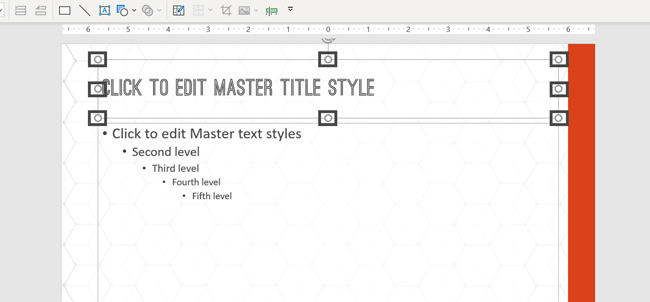
Next, suit the size and position of your title placeholder. To do that, simply select the placeholder and:
- Employ the 4-headed pointer cursor to move the placeholder to where you desire it on your slide.
- With the placeholder nonetheless selected, drag the resizing handles (the 8 little white circles) in or out to resize the placeholder.
There is no right size and position for your title. Yous'll but desire to make certain that information technology fits your slide.
You'll besides desire to call up about how much text y'all're expecting people to type into the placeholder for their slides. Make sure the placeholder is big enough to fit the typical scenario.
C. Ready your vertical text alignment
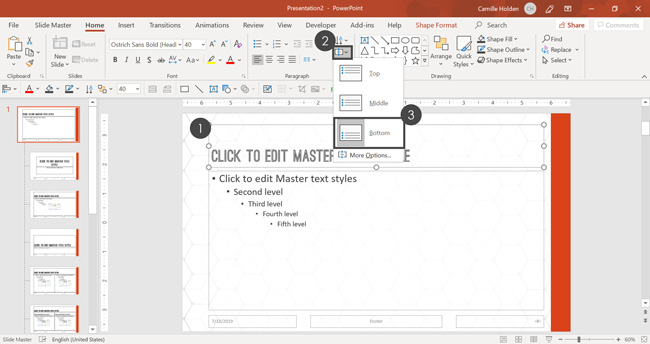
Next, gear up the vertical text alignment for your title. To do that:
- Select your title placeholder
- From the Abode tab, select the Align Text dropdown menu
- Choose your desired vertical text alignment (I'll choose Lesser for mine)
Unless y'all have a specific reason to do otherwise, I recommend that you choose Bottom for your vertical text alignment. That way your title text will always stay perfectly aligned at the bottom, from slide to slide.
This helps avert jumping titles for any slides that accept more than one line of text.
On the flip side, if you plan on having short titles for all your slides (no more than 1 line), I recommend using the Middle text alignment instead.
Regardless of what yous decide, brand sure you exam dissimilar title lengths to see what will work best for your PowerPoint template.
D. Align the guides to the title
Since we added our guides in the first role of this series, now we'll set them to align with our title.
- Elevate your Horizontal Guides to match the top and the bottom of your title placeholder (add together more guides if necessary)
- Drag your Vertical Guidesto match the left-hand and right-hand sides of the championship placeholder (add together more guides if necessary)
To add a new guide, merely start dragging an existing 1, and then hit the Ctrl key on your keyboard earlier y'all let become.
Adjusting your guides like this will make adjustment objects on your slides much easier as your Smart Guides will automatically snap them together.
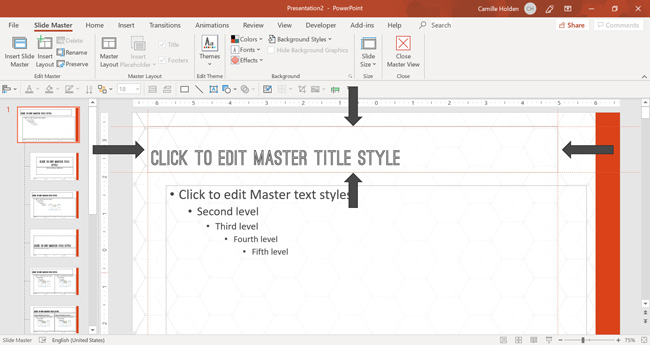
Note: If your Guides are not visible, just right-click on a bare part of your slide and select Grid & Guides, and so Guides. That will plow them on. Alternatively, you can get upward to the View tab in the Ribbon and select Guides within the Evidence area.
2. Format the Text placeholder
The Text placeholder on your Parent Slide is special in that it will dictate the default formatting of all the other content placeholders in your presentation (except for the Title placeholder and the Footer placeholders).
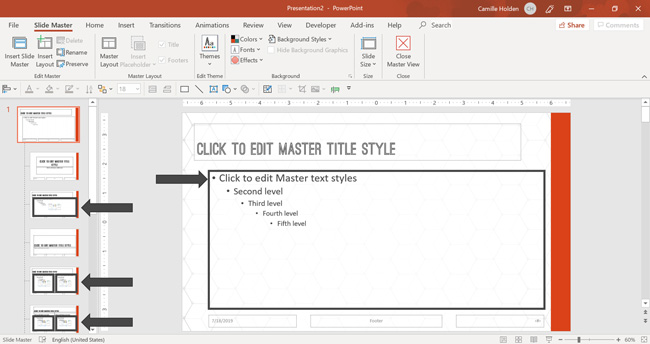
Setting the default hither on the Parent Slide is important because it makes it a lot easier to brand fast and consistent changes to swathes of content down the road.
Later on in this template series, I will evidence you how to format away from this default beliefs on the Child Slides. But start you want to ready its default formatting.
A. Resize and position the Text placeholder
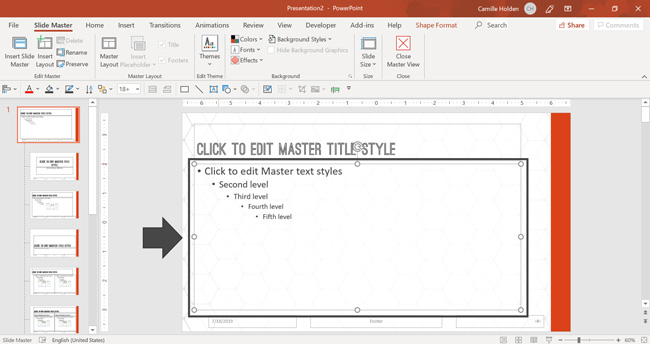
The offset thing to do with your Text placeholder is change its position and/or size and then that it'due south exactly aligned with the Title and Footer placeholders. To practice that:
- Select the Text placeholder and when the cursor becomes a four-headed arrow, elevate the placeholder to the pinnacle and left side so that information technology is aligned with the Title placeholder.
- With the placeholder still selected, use its sizing handles to arrange its size until it is simply right (factoring the amount of text that you predict you'll type in, besides every bit the alignment with the other placeholders).
B. Align the guides
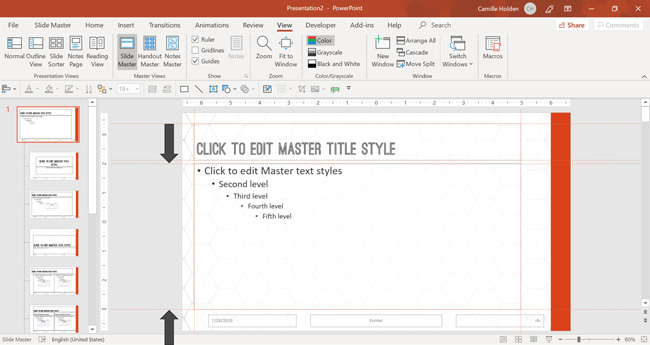
In this footstep, you need to align the horizontal and the vertical guides to that they align with the Text placeholder. To do that:
- Drag the horizontal guides to lucifer the height and the bottom of the Text placeholder.
- Similarly, drag the vertical guides to lucifer the left and correct-paw sides of the Text placeholder.
C. Change the font size
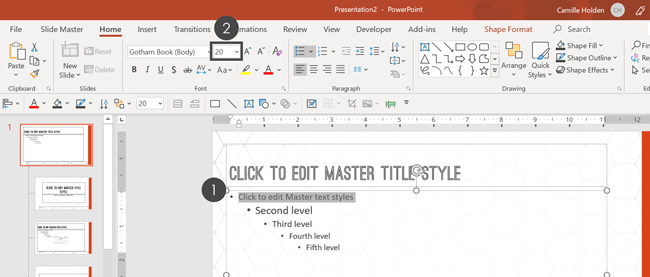
The next stride is to change the font size of the different levels of text within the placeholder. To do that:
- Select the first level of text
- In the Font Size box, type in 20 and hit Enter
Repeat these steps for the second, tertiary, fourth, and 5th levels of bulleted text, changing their font sizes to eighteen,16, 14, and 14 respectively.
D. Adjust and align the bullet points
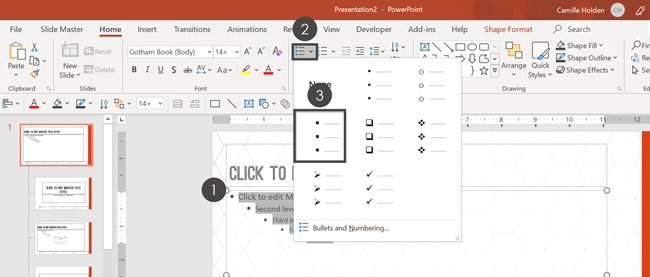
Once you have gear up the font size, it is of import to conform the bullets.
- Select all the text styles in the content placeholder
- In the Paragraph group, click on the Bullets and Numbering dropdown
- Click on the foursquare style bullets
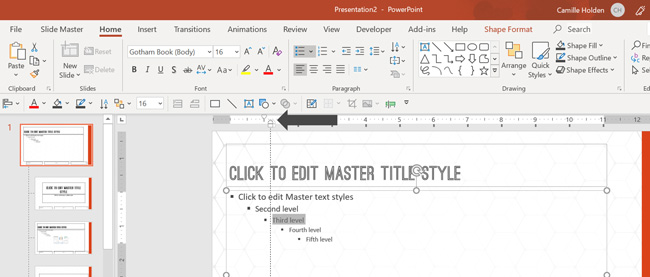
Adjacent, you have to arrange the indent of the bulleted lists so that it appears in all your slide layouts. To do that:
- Select the bulleted listing you want to arrange
- Click, concord, and drag the desired indent marker. In our example, we'll drag the hanging indent mark.
- Repeat this for each text level
You tin can adjust the bullets as per your personal preference. Based on your cognition of how someone is going to exist using this template, yous might decide to add more or less infinite.
Note: My recommendation as per Julie Terberg and Echo Swinford'southward volume, "Building PowerPoint Templates Step by Stride with the Experts," is to e'er make certain that y'all format every single item you have available. That includes formatting each text list level.
You lot can encounter their book on templates hither.
That way, yous have everything set in case someone decides to break the rules or do their own matter. This inevitably happens with templates and you lot desire to be prepared for it!
three. Formatting the footers of your template
The footer section of the Slide Master has three types of placeholders:
- Slide number
- Footer text
- Date and time
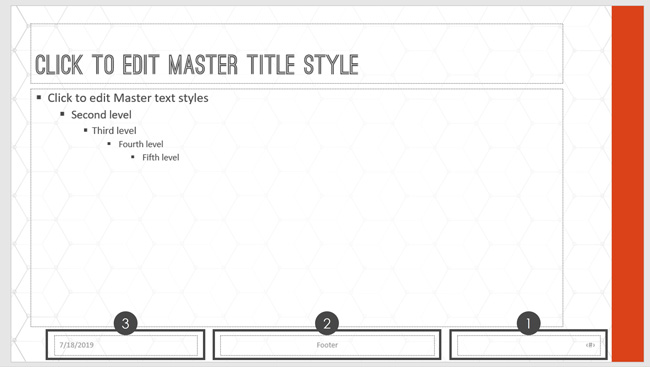
A. Set the font size for all your footers
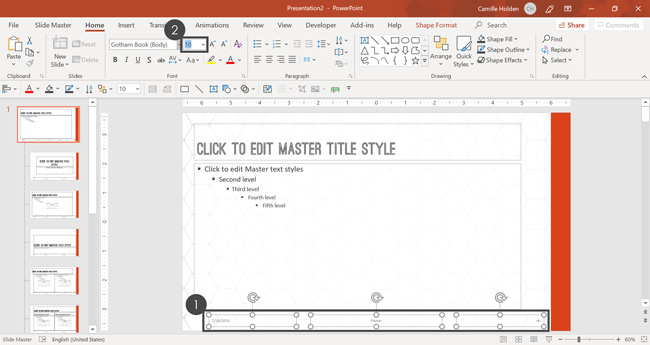
The kickoff step is to change the font size of the footer placeholders. To do that:
- Select all your footer placeholders holding theShiftkey.
- In theFont Sizedialog box, type 10 (of whatever your desired font size is) and striking Enter.
B. Resize and position the placeholders
The next thing to practise with the footer placeholders is to change their position and/or size so that they're aligned with the rest of the placeholders. To practise that:
- Select each placeholder and when the cursor becomes a four-headed arrow, drag the placeholder to its desired location (apply the guides for assist).
- With the placeholder still selected, utilise its sizing handles to adjust its size until it is but right (factoring the amount of text that you predict you'll type in, as well as the alignment with the other placeholders).
- Repeat this for each placeholder.
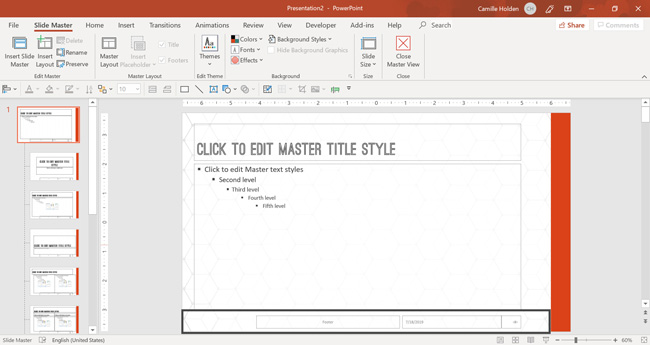
If you want to be 100% certain that all the Footer placeholders are the same, select them 1 at a fourth dimension and go to the Shape Format tab in the Ribbon. In the Size section, verify that the height of the placeholders is the same.
In this example, notation that I am swapping the positions of the Appointment & Fourth dimension and Footer placeholders.
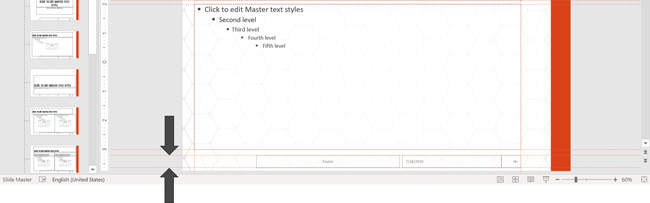
Remember to too add new guides around these placeholders to assist keep them in place. Here, I'm only going to add the peak and bottom guides, and so as to avoid confusion and overkill.
C. Format the Slide Number placeholder
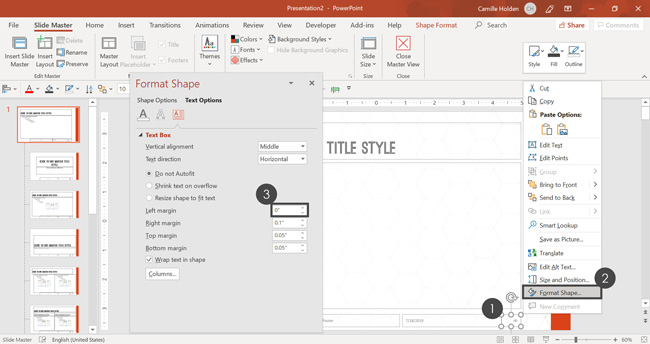
Next, we'll need to adjust the formatting of the text inside the slide number placeholder. To do that:
- Correct-click the placeholder, click onFormat Shapeand select Text Options
- Open the Text box tab
- Blazon 0 for the Left margin and striking Tab or Enter on your keyboard
Note: For the slide number placeholder, y'all can also add symbols as I take here (such as a bar and two spaces), in order to create a visual interruption from the other placeholders.
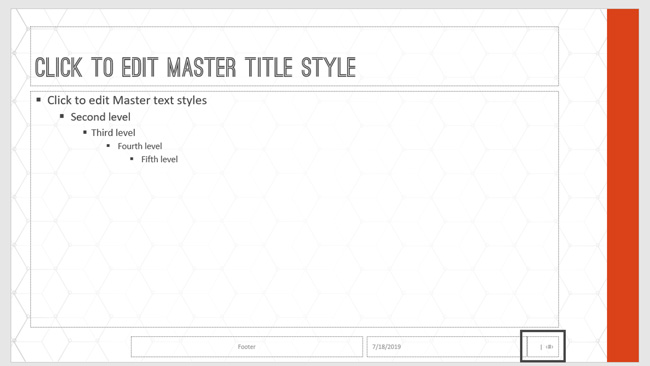
Slide numbers are oft tricky to get correct when trying to properly display them on all your slides. To expand your knowledge and learn how to add slide numbers in PowerPoint (and how to troubleshoot them), read our guide hither.
D. Format the Date and Time placholder
The next thing is to format the date and fourth dimension footer placeholder. Y'all tin cull any kind of format you lot similar. Below you'll detect the steps that I took in the video tutorial at the top of this folio.
Kickoff, select the placeholder and hit Ctrl+R on your keyboard to right-align the text to the right (and so that it'due south flush with the slide number to the right).
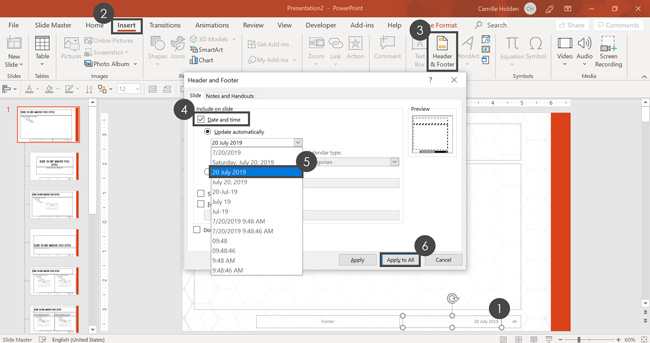
Then, you lot'll want to choose what kind of appointment formatting you lot want. To do that, simply:
- Select the Date and fourth dimension placeholder and hit Ctrl + R on your keyboard to align the text to the right.
- Go upwardly to the Insert tab and in the Text group, select Header & Footer.
- Click on Engagement and time then that at that place is a checkmark next to it.
- Click on the Date dropdown and select the option as required. In this example, nosotros are going to select December 30th, 2017.
- Click Utilise to All to save the changes. You lot can come across that the engagement and fourth dimension text has changed appropriately.
Eastward. Format the Footer text placeholder
The last default placeholder to format on the Parent Slide here is the Footer text placeholder. This placeholder is designed for a tagline, an author'southward name, or cited sources. For helping citing sources in PowerPoint, read our guide here.
All yous need to do hither is to select the placeholder and hitCtrl+L on your keyboard to left-align the text. This way, information technology is adjacent to the logo and the text inserted will extend out towards the correct.

F. (Optional) Add together your logo
While all the default placeholders accept now been ready and formatted correctly, in that location is still one element that you can add on the Parent Slide of your Slide Master; and that is a logo.
This is optional, and so don't experience obligated to add one. In fact, a common practice today is to display the logo more sparingly and merely place it on certain Kid Slide Layouts.
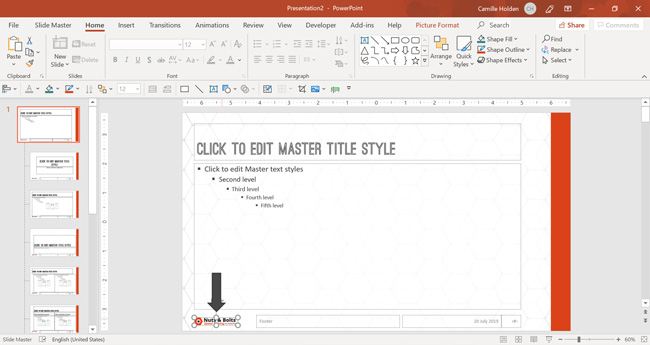
To add a logo, simply:
- Copy the logo and hit Ctrl+5 to paste information technology on the slide. Make sure you lot paste it every bit a PNG because it won't lose its quality over time, whereas a JPEG volition.
- Resize and reposition the logo to make it fit nicely in its desired position. Alternatively, yous can click on the Motion picture Format tab in the Ribbon and fix the elevation to 0.35 to make it even with the other placeholders.
You lot can also utilise this aforementioned technique to add together a watermark to your PowerPoint slides. To see how to add a watermark to your slides (similar Draft or Confidential), read our guide hither.
Part #3. Creating Custom PowerPoint Template Slides
In the final office of this guide, you lot'll finalize the slide layouts that yous want to apply in your PowerPoint presentation by formatting the Child Slides.
TheKid Slides stand for the blueprints for each blazon of slide included in your template. By default, your Child Slide layouts will inherit your Parent Slide formatting. But equally y'all will see, you tin can tweak these layouts to run across your individual needs.
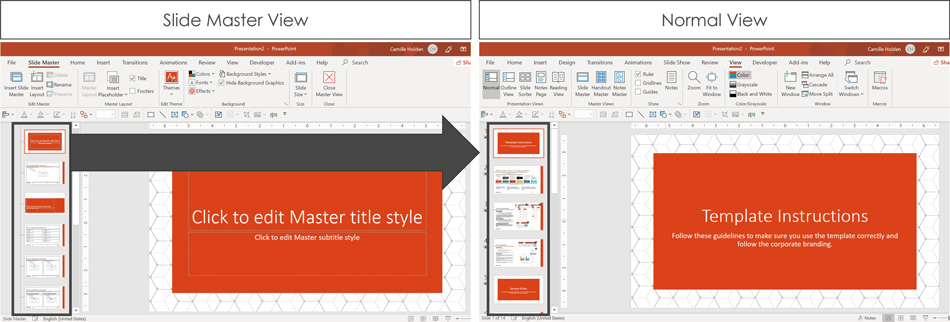
The key to designing expert Kid Slide layouts is to keep in mind how the end-user is likely going to insert content on each type of slide. Yous want to make it easy for everyone to quickly fill them in when using your template.
In this department you'll learn how to:
- Remove background graphics so that they're hidden on your Kid Slide layouts,
- Make the slide background an existing picture,
- Rename your custom Kid Slide,
- Add prompt text to assist the template user properly make full in each layout,
- and more!
1. Format the Title slide layout
The first step is to edit the Title slide layout. This layout is designed to exist filled in with the title and full general information about your presentation.
Typically, its looks slightly different than the residue of the layouts. It usually has less text and fewer images/objects, and it stands apart.
That being said, it nonetheless needs to match the other layouts overall and await like it'due south a role of the same template.
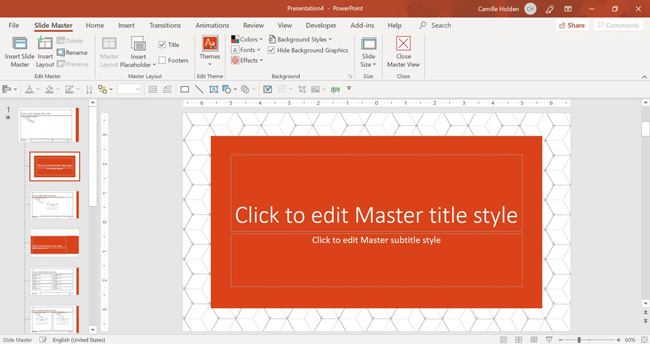
The beginning thing we need to practice when formatting our Title slide layout is to recall nearly the background. Typically, a Title slide will have a slightly unlike background from the regular Content slides.
Notwithstanding, because the groundwork has been assault the Parent Slide, this means that you will have to deviate from it. There are two ways to arroyo this – let'southward get over each one.
A. Hide the background graphics on a Child Slide - Method #1
The showtime method for hiding annihilation in the groundwork (graphics such as the logo, background patterns, design elements, etc.) is to insert a blank rectangle to encompass it upward.
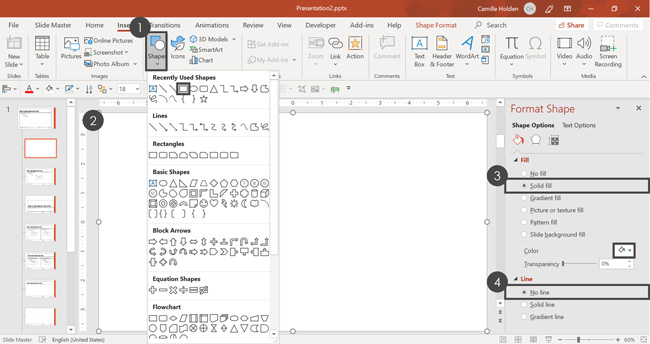
To encompass up your slide background with a white rectangle, merely:
- Go to the Insert tab on the Ribbon, click on the Shapes dropdown, select a rectangle.
- Describe in the rectangle then that it fills out the entire slide.
- Alter the rectangle'due south fill color to White.
- Remove the rectangle's outline.
Side by side, we'll need to make sure the placeholders are visible on the slide, in front of the newly inserted rectangle.
To do that, with the rectangle notwithstanding selected, become to the Shape Format tab on the Ribbon, click on the Transport Backward dropdown and select Send to Back.

Note: Keep in mind that covering up the background elements similar this means that the logo (and any other paradigm you've pasted onto the Parent Slide) will exist hidden. If you want that chemical element to be visible on this Child Layout, you'll accept to re-create/paste it in.
B. Hide the background graphics on a Child Slide - Method #two
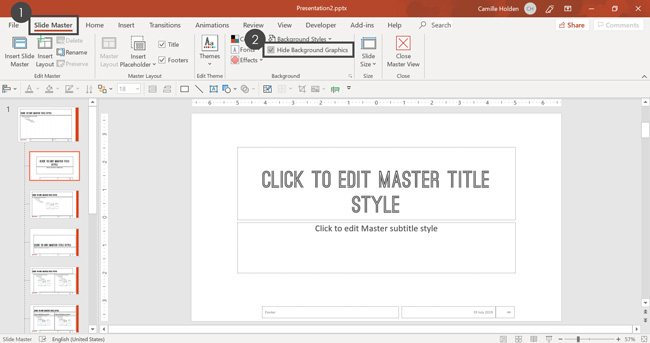
The "technically better" fashion to do this is to use the default PowerPoint feature fix to exercise this for you. Just:
- Go to the Slide Master tab in the Ribbon
- Click on Hide Background Graphics to add a checkmark next to it
This hides anything from the Parent Slide that isn't a placeholder. This includes any background images or patterns, logos, and other design elements.
You can hands make them visible again by unchecking the Hibernate Background Graphics checkbox.
C. Add in a new background for this layout
At present that nosotros've removed the background inherited from the Parent Slide layout, nosotros'll demand to add in background elements we want on this item Child Slide.
While the groundwork image tin can exist different, nosotros want to keep it consistent. Then let'south go support and take some elements nosotros can reuse.
First, navigate back to the Parent Slide and select the blueprint image (without the gradient). And so hitting Ctrl + C on your keyboard to re-create it.
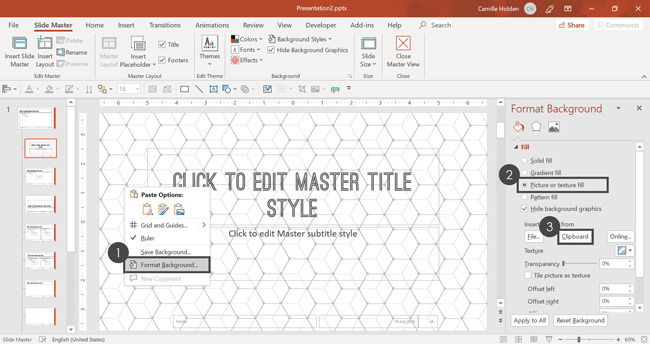
Then, go back to your Title slide layout and:
- Right-click a bare area on your slide and select Format Groundwork.
- In the Format Background tab, select Picture or texture fill up.
- Select Clipboard.
This pastes whatever is currently copied on your clipboard into your slide groundwork.
Annotation: Pasting an object straight into your slide groundwork like this means that information technology can no longer exist edited in your PowerPoint template.
If instead you paste it directly onto the slide as an prototype, yous can always go back in and make adjustments to the image, and therefore to the background too.
It'south up to y'all whether y'all desire your template's users to be able to edit the background image or non.
So if you're putting the image straight into the slide background, I recommended that you lot simply do then when you are certain that this is the terminal groundwork image y'all want to utilise.
D. Add in an extra design chemical element
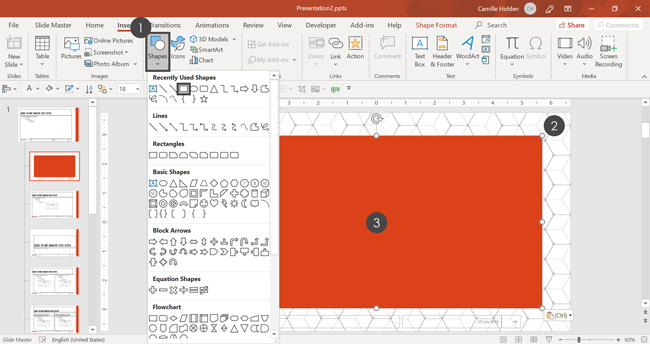
The next stride is to add together in a design element that matches the full general theme and fashion of the template. To do that:
- Go to the Insert tab on the Ribbon, click on the Shapes dropdown and select a rectangle.
- Draw in the rectangle (it should be filled with the commencement accent colour of your theme) so that information technology fills about fourscore% of your slide.
- Make sure the rectangle is centered and in the eye of the slide.
Side by side, permit'southward send the rectangle behind the placeholders.
To do that, right-click the rectangle, open up the Send Astern dropdown and select Send to Back.
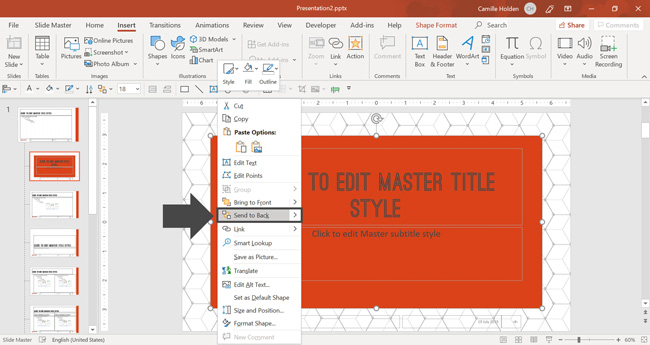
E. Suit the placeholders
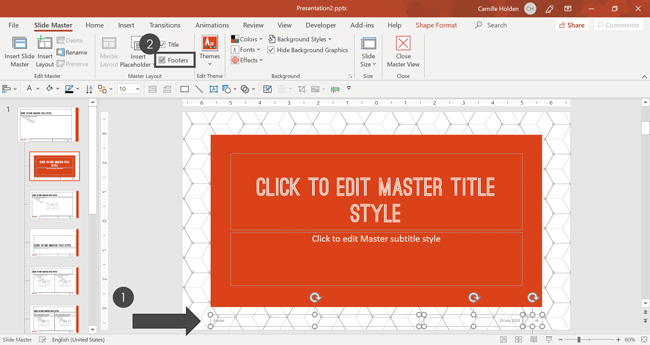
Showtime, adjust your Title and Subtitle placeholders. To do that, simply select the two placeholders and:
- Change their Font colour to white.
- Adjust their position and size on the slide, keeping in heed how much room yous need to go out for the text.
Side by side, let's address the Footer placeholders.
Even if you don't desire footers visible on the Title slide of your template, I don't recommend deleting them hither in the Slide Principal View.
Why? Because if someone decides to use them despite your instructions, you still want them to appear correctly and lucifer the rest of the template.
F. Format and hide your Footer placeholders
To format and hide your footer placeholders, simply:
- Format the footer placeholders the way you'd like them to appear if they were used.
- Go upwardly to the Slide Master tab in the Ribbon and deselect the Footerscheckbox.
Note: Even if your footers stay selected on this Title slide layout in the Slide Master View, they typically don't appear on that Title slide in the Normal View.
To plough them on, you have to get to the Insert tab in the Ribbon and select Header & Footer. There, you lot tin can plow them on.
So, unless yous truly want someone to NEVER be able to add a page number, engagement and time, and footer text to the Title layout, then I recommend leaving them on the Child Slide, to keep that option open.
If you deselect the Footers checkbox in the Slide Master View as nosotros did above, then when someone tries to insert footers in the Normal View, they volition non appear.
To learn all most how to add slide numbers in PowerPoint (and troubleshoot ones that won't show upwards), read our guide here.
Ane more thing y'all might discover is that the guides are not visible on the Title slide. Since this is a Kid Slide, you lot can't edit the guides here.
Unfortunately, the guides yous assault the Parent Slide will likely not match the content you have on the Championship slide (and whatever Child Slide whose content deviates from it). There is no way around this in PowerPoint at this point in fourth dimension.
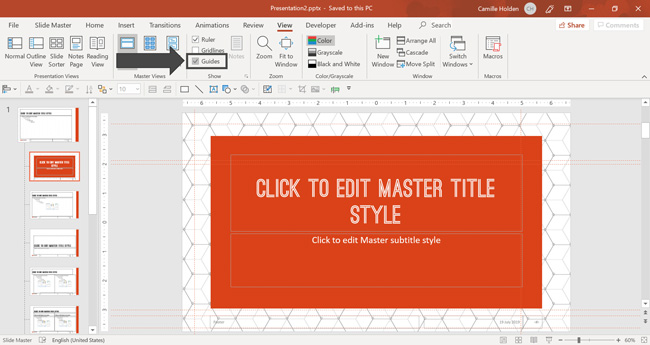
2. Format your Title and Content layout
The next step is to edit the most normally used PowerPoint slide in whatever presentation, the Championship and Content layout.
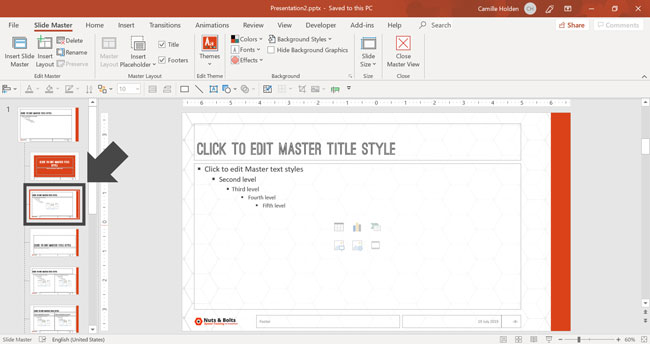
This specific slide layout volition look near identical to to the Parent Slide layout that we've already set up at this indicate. This means that there isn't much we have to practice to alter it.
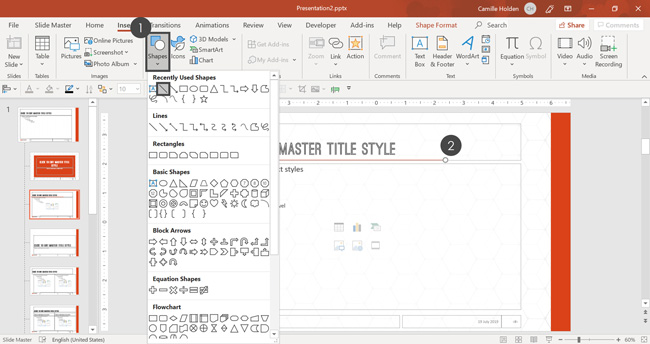
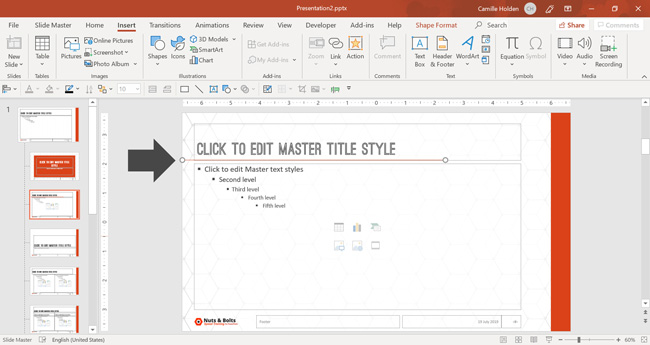
Yet, in this instance, nosotros are going to add together one more pattern element to the layout, which is a directly line. To practice that simply:
- In the Inserttab on the Ribbon, click on theShapes dropdown and select the direct line. To make sure it's 100% straight, hold the Shift fundamental as you lot depict in the line.
- Elevate the straight line and place information technology underneath the championship. It should perfectly fit in cheers to the Smart Guides. Brand certain that it'south long enough to go past the text in the Title placeholder.
The reason you don't add together this line to the Parent Slide is that the layout has to be formatted to work for the majority of the layouts in your template.
That means that the Parent Slide has to be relatively blank-bones. You can ever add extra elements in the Kid Slides.
3. Format the other Child Slides
From here onward, you lot will need to format each of the Kid Slides to match the content that goes in them.
You volition want to follow the aforementioned procedure every bit in Footstep #2 to a higher place, keeping in mind what each Child Slide is designed for and how the content should exist placed.
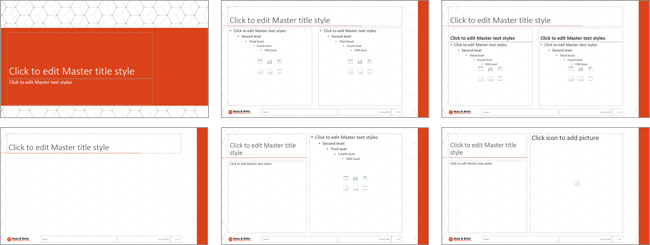
Some layouts will require more than custom formatting and design elements.For example, for the Divider slide (the first slide in the examples below,) I take added a rectangle that matches the design elements on the Title Slide layout.
four. Optional step: Create your own Child Layouts
In addition to the default Child Slides that PowerPoint gives you, you have the pick to create your own.
You tin can cull to create your own if you have a very specific blazon of slide that you lot'll need to create over and over in your presentation.
If you make the slide under 10 times, information technology may not be worth bottleneck up your Slide Primary area. But if you use it frequently, creating a layout template for that type of slide will save yous endless hours.
Here are the kinds of slides you lot may want to create a custom layout for:
- Tabular array of Contents / Calendar
- Quote page
- Team bios / Team headshots
- Case studies
- Thanks / Acquire more
- Nearly us
- Data dashboard
- and more than
Keep in listen that the blank layout (and other blank variations) can always be used to create more one-off slides.
Creating a custom agenda slide
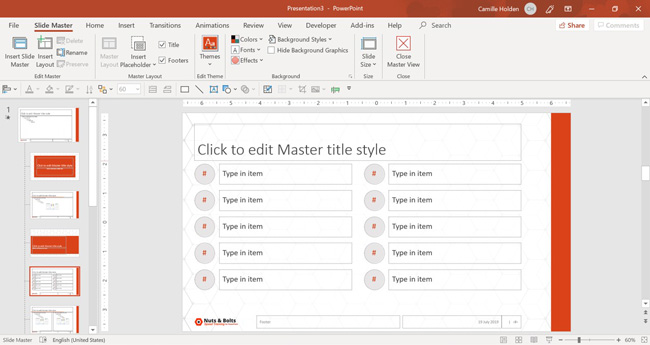
In this instance, we're going to add a custom Calendar Kid Slide. To add this custom layout:
- Become to the Slide Master tab in the Ribbon and click Insert Layout. Y'all'll see that a new Child Slide gets added in with just a Championship placeholder and the Footer placeholders.
- Add any additional placeholders y'all need (Slide Master tab > Insert Placeholder) and format them as per your requirements. In this instance, I've added 20 text placeholders that I've resized and formatted.
- Accommodate the prompt text in the placeholders to fit the respective content need. For example, in the image below you can write "Type in detail" then that the user knows to blazon in the correct text into each placeholder.
Annotation: You can change the shape of a placeholder, as well as accommodate all other properties of a typical shape. That means that you lot can as well add make full, outline, furnishings, etc.
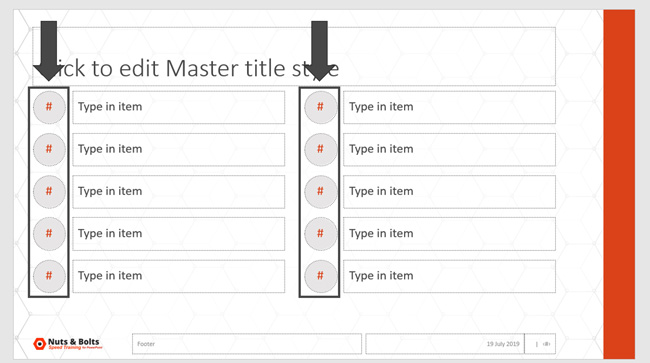
This is how I was able to create the round TOC numbers in this layout:
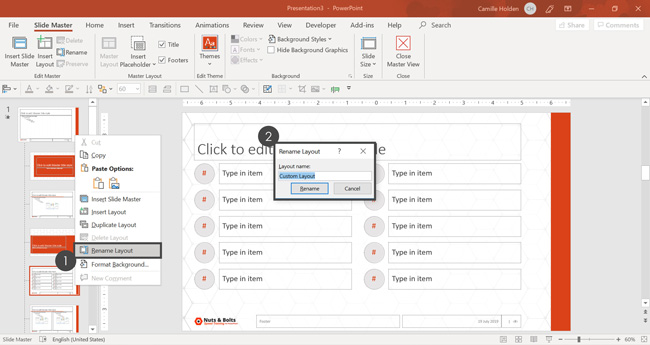
Y'all can too rename the custom Kid Layout by:
- Correct-clicking it in the Thumbnail View on the left-hand side and selecting Rename Layout.
- Type in a helpful name and click Rename.
Note: You tin can perform these steps for all custom Kid Slides. You can also create custom layouts for a lot of slides such equally for products, case studies, contact us, etc.
Notwithstanding, attempt not to go overboard because y'all don't desire to accept a layout area packed full of slides, which will confuse the user.
Only for very oftentimes occurring slides, I highly recommend making a custom layout.
There are likewise other slides in the template such equally the content slide with subtitles or a bare slide with a championship. You can format them per your requirements.
five. Finalize your PowerPoint template
Now that the template is almost finished, you still have a few critical steps.
A. Set animations and transitions
The first matter is to ready the animations and transitions for your slides. For all placeholders that you lot desire to automatically animate in your template, simply select it and use your animation.
Note: Keep in mind that animations should be used in your template VERY sparingly. That's not only because animations can be overly distracting, only information technology's also because the user of your template may not want to take animations set automatically for them.
In short, brand sure y'all create the template in a way that makes your users' life easier, rather than harder.
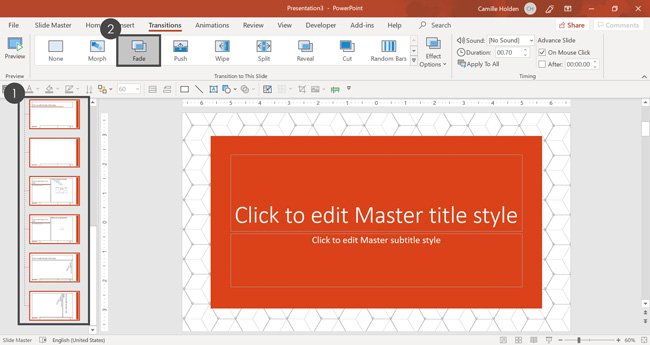
In one case that's done, let's set the slide transitions. To do that, simply:
- Select all of the slides in your template (in the Slide Master View).
- Click into the Transitions tab in the Ribbon and select your preferred slide transition.
Next, allow'south make certain we close the Slide Master View since we are done with it. From the Slide Master tab in the Ribbon, clickClose Master View.
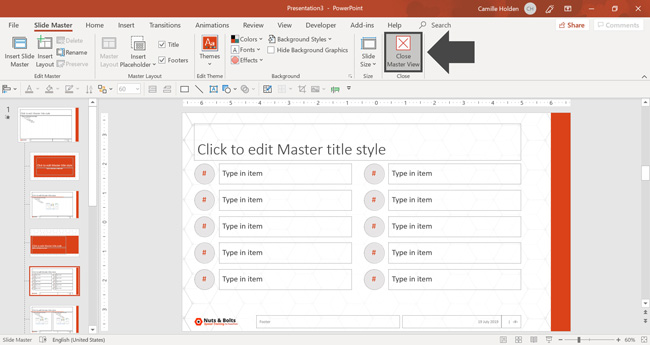
Note: At that place is too a Notes Master and Handout Master in PowerPoint that y'all can gear up up and format. These masters determine the look and experience of your PowerPoint handouts when yous print them.
To learn how to format these elements in regards to printing multiple slides per page in PowerPoint, read our guide hither.
B. Stress test your template
It is highly recommended that yous test your template before y'all distribute information technology. That way you catch whatsoever errors before your users do.
Here are some means you can stress test your template:
- Try to use it in a variety of different ways to see if it breaks
- Blazon in all kinds of dummy text
- Delete things and turn them back on again
- Paste slides in from other templates to see what happens in your template
Final Template Thoughts
And that's how to create a PowerPoint template that works the way it is supposed to.
You now have the foundational skills to first creating your own PowerPoint templates and edifice beautiful and tailor-made presentations.
If you want to learn more about edifice and deploying your template in professional settings, I recommend checking out my pace-by-step training course, run into details here.
Every bit a quick recap of everything we covered, you learned how to:
- Navigate the Slide Master View,
- Create and insert slide backgrounds, as well as hide background graphics,
- Format each of the elements on the Parent Slide layout,
- Format each Kid Layout and create your own custom Child Slide layouts,
- Add together and accommodate the Guides on your Parent Slide layout,
- And more than!
If you enjoyed this in-depth tutorial, y'all'll love our PowerPoint training courses and tutorials that you tin can larn more near hither.
Your PowerPoint Misery Ends Here!
Sign up at present to see how 4 little-known secrets are turning peoples' PowerPoint headaches into high-fives… and saving them at least xl hours each year.
Yous'll also get our newsletter with the best PPT tips on the spider web, which y'all tin unsubscribe from with i click.
We collect and protect your information in accordance to our Privacy Policy

How To Use Template Powerpoint,
Source: https://nutsandboltsspeedtraining.com/powerpoint-tutorials/how-to-create-a-powerpoint-template/
Posted by: maggardrembed83.blogspot.com
0 Response to "How To Use Template Powerpoint"
Post a Comment